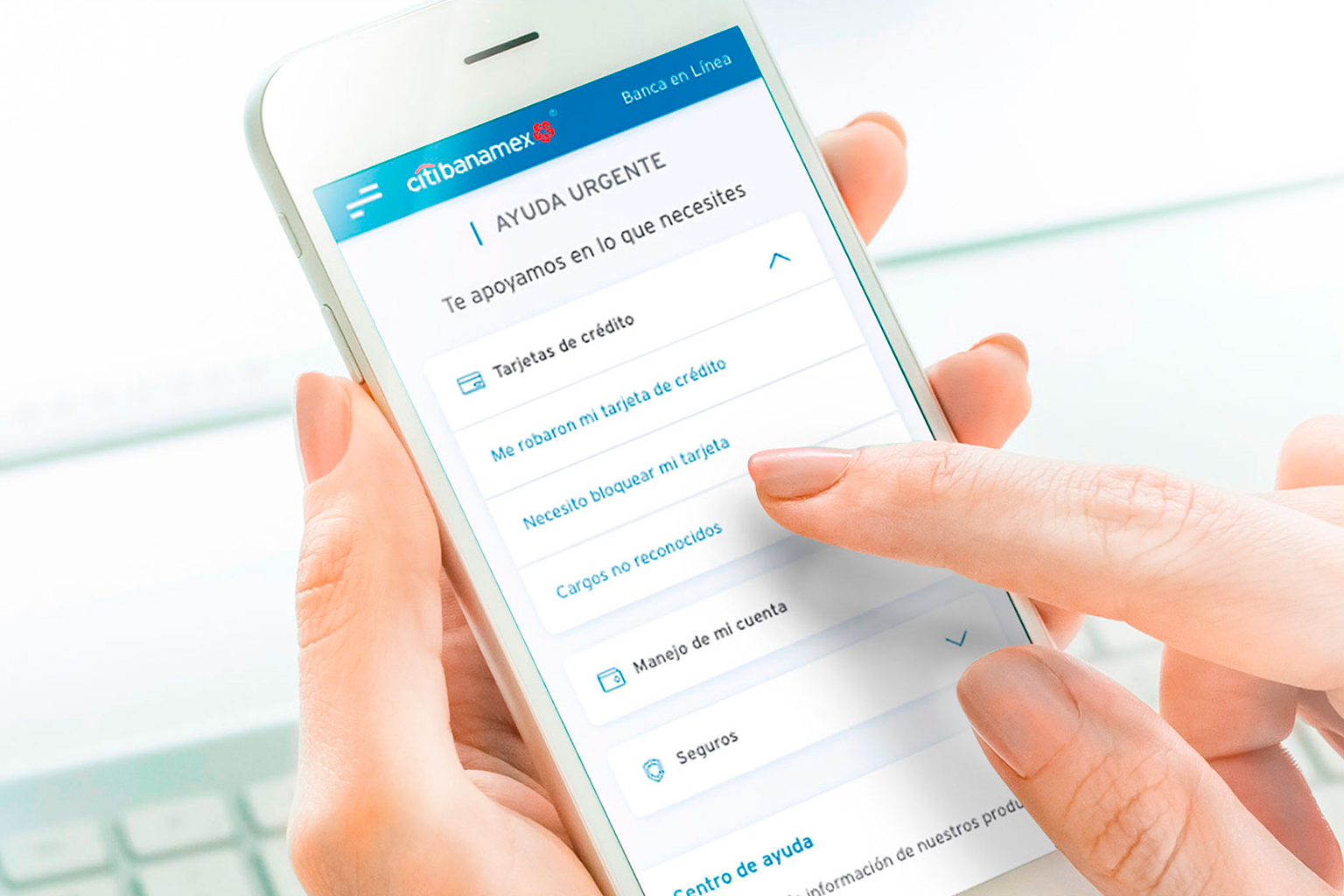
What started as a one-week FAQ page, became Mexico's first bank Help Center — reducing call volume, cutting support costs, and giving Citibanamex customers a place to find answers on their own terms.
Citibanamex's digital portal was heavily focused on selling products and services. It had dozens of URLs — for credit cards, mortgages, financial education, press, events — but almost no support for existing customers.
When users ran into issues, the only option was to call Audiomático, the bank's phone service. Every call had a cost. And for customers, the experience was far from smooth: long wait times, transfers between agents, and all of it just to answer a question that could take seconds to resolve.
The product leads came to us with a straightforward ask: build a FAQ page. A simple list of the most common questions users called about, pulled from Audiomático's records.
A one-week task. Reasonable scope. Easy to deliver.
But my colleague and I saw something bigger hiding behind it.
A flat list of 200+ mixed questions wasn't a solution — it was a different version of the same problem. Users would still have to hunt, scroll, and guess their way to an answer. The friction didn't disappear, it just moved from the phone to the screen.
We proposed something else: a structured Help Center. Not just a page, but a self-service support hub — categorized by product, organized with UX methods, and built for the way users actually think.
At the time, no Mexican bank had a Help Center. But Google, Facebook, Uber, and several international banks had already proven the model worked. We mapped the competitive landscape — direct and indirect — and presented the evidence: a proper help center reduces call volume, increases customer satisfaction, and scales without adding headcount.
The stakeholders saw the potential. We got the green light — along with more time and resources to do it right.
We already had defined user personas for the bank's main products. The biggest design challenge wasn't visual — it was structural: how do you organize 200+ questions in a way that feels intuitive to someone who's frustrated and just wants a fast answer?
The core structural decision was to stop thinking about the questions themselves and start thinking about the user's mental model. People don't search for "FAQ #147" — they think in terms of their product: my credit card, my mortgage, my app.
We organized everything around product and service categories, with sub-branches for specific topics within each. This turned a wall of text into a navigable, scannable system.
We started loose — low-fidelity sketches to validate the structure before committing to any visual direction. Feedback came fast, and we iterated in cycles: weekly syncs with the development team kept technical constraints visible early, and bi-weekly stakeholder reviews kept the business goals in check.
Simple, clean, and mobile-first. Built on top of Citibanamex's existing design system — the focus was always clarity and speed of resolution, not visual complexity.
After one month, the high-fidelity prototype was ready. We ran usability tests with real Citibanamex customers — not internal stakeholders, not designers, but actual users who called Audiomático regularly.
No one expected a Help Center to exist on the bank's website. But once they used it, the reaction was consistent: "This is a great idea. This would have saved me so much time." The need was real — it just hadn't been met before.
Tests were successful. Two additional weeks were used to finalize the question backlog and define the phased delivery with development — prioritizing the categories with the highest call volume first.
Because new questions kept coming in as we worked, we defined a phased handoff strategy with the development team — starting with the three categories that drove the most Audiomático calls.
Highest call volume category. Topics ranged from payment due dates and limits to PIN recovery and card blocking.
Complex product with high user anxiety. Common questions around balances, payment schedules, and documentation.
App and online portal support. Password resets, feature navigation, and account access were the top drivers.